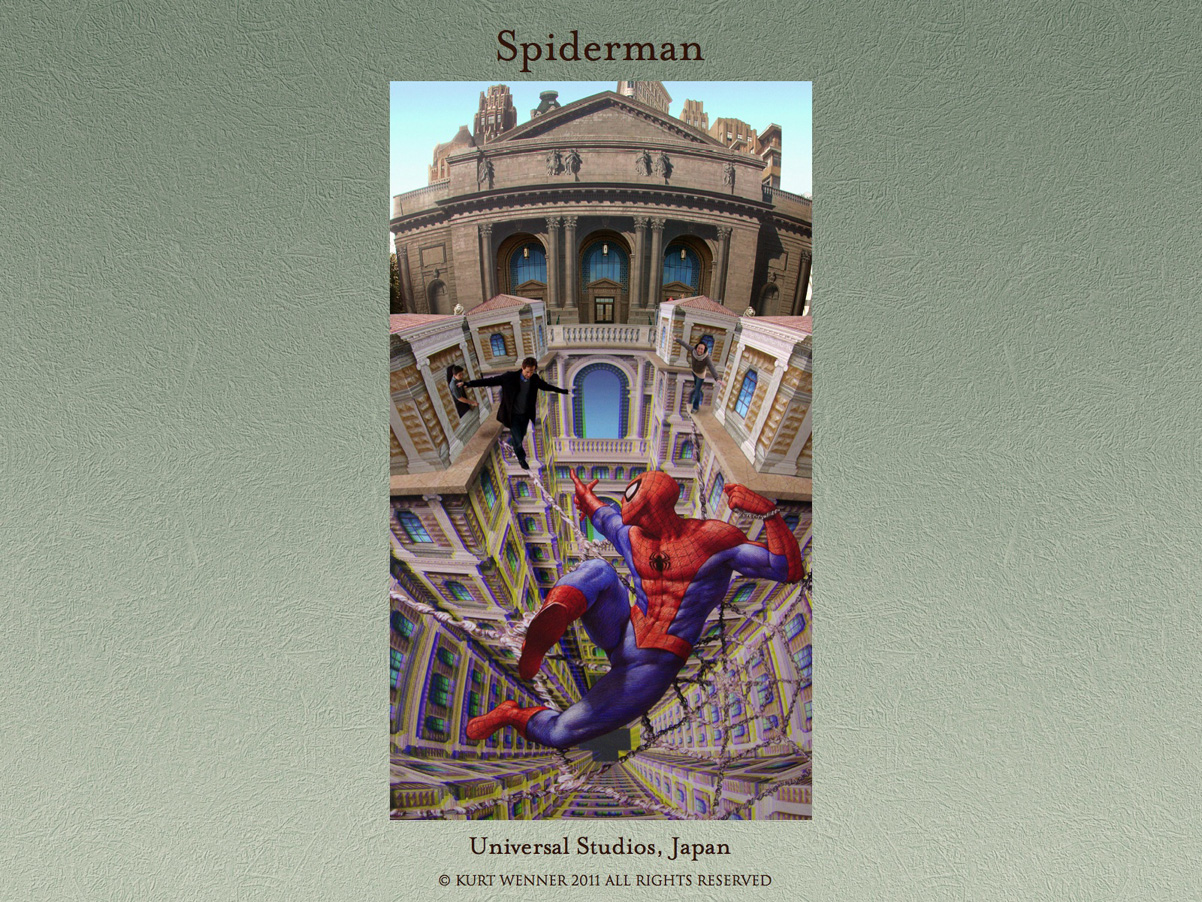
'3d Street Art', also known as '3d chalk art' is 2-dimensional artwork drawn on the street itself that gives you a 3-dimensional optical illusion from a certain perspective. It can be very breathtaking, realistic and at the same time very captivating once you get the angle right. Kurt Wenner is best known for his 3d Street Art and has made it a craze around the world. I first came across it on Facebook and now 3d street arists are gaining much popularity these days. Famous brands are already taking advantage of the public’s curiosity on 3D street paintings to create awareness for their new products.
I decided to write a post on this 3d art because the first time that I saw it, I was totally mesmerized and gobsmacked. It is so incredibly clever and original, and I had never seen anything like it before. It makes me think, 'could I do something like that if I put my creative skills to the test?' Probably not. But worth a try one day I think...
Tuesday, 24 April 2012
Some of my work - Definitely a proud moment
In March this year, I volunteered to do some event photography for a local music festival, which was organised by a 3rd year Music Journalism student. My role as photographer was to use VIP access to capture a variety of shots of each of the 10 acts. The festival was a huge success and I was really happy with the images that I got out of the experience. The festival itself was based outside the Guildhall in the town centre, and the students had set up a stage and a DJ tent for people to enjoy for no charge. 'Smile in the Square' was a brilliant day for me, as a photographer, because it gave me some extra experience in event photography. Here are just a few of the shots:
This experience was one that I will remember for a long time, and the images will all be revealed in my portfolio. I took over 600 images during the day, and have narrowed them down to only 300-400. The guys who led the festival should be incredibly proud, as I got to see first hand all of the preparation that went into it. It really made me think about the fact that all musical acts come from small local bands - so all of the acts that I photographed could one day be as big as some of the worldwide artists that we see today.
Girls, Girls, Girls
From doing a lot of research into portraits in my Representation project, it reminded me of an exhibition that I visited a few years ago - Women of Our Time: Twentieth–Century Photographs from the National Portrait Gallery
"This critically acclaimed exhibition is a stunning collection of photographic portraits of women whose brilliance, courage, style, and unflagging spirit have helped shape America as we know it." - National Portrait Gallery website
For me personally, this exhibition was incredibly inspiring as a woman, to do exactly what I want, when I want to do it. The empowerment of women is so important to our lives today, and this exhibition really put it into perspective. My favourite image that was up, was the picture of Marilyn Monroe, because she, to me, is one of the most inspiring women of all time. She is sexy, elegant and inspirational to everyone. In each image, the composition shows the woman in the centre of the frame, so that the eye is drawn directly to them, rather than to anything else in the image. It is almost like the women are empowering the images themselves, rather than being in a vulnerable state, like in a lot of photographs.
"This critically acclaimed exhibition is a stunning collection of photographic portraits of women whose brilliance, courage, style, and unflagging spirit have helped shape America as we know it." - National Portrait Gallery website
For me personally, this exhibition was incredibly inspiring as a woman, to do exactly what I want, when I want to do it. The empowerment of women is so important to our lives today, and this exhibition really put it into perspective. My favourite image that was up, was the picture of Marilyn Monroe, because she, to me, is one of the most inspiring women of all time. She is sexy, elegant and inspirational to everyone. In each image, the composition shows the woman in the centre of the frame, so that the eye is drawn directly to them, rather than to anything else in the image. It is almost like the women are empowering the images themselves, rather than being in a vulnerable state, like in a lot of photographs.
100 Years Ago...
So, as it is the 100th anniversary of the sailing of the Titanic, I thought I would do a bit of research into a photographer who was actually on board the ship. Father Frank Browne spent only a small amount of time on the ship, but the priest captured some of the most iconic and enduring images of the ship - images upon which our naiive modern-day knowledge of the interior of Titanic and the atmosphere on board are based. Father Browne was so much more than an amateur photographer who snapped away. The fact that he has captured real people going about their business on board ship, and that the majority of those people were dead a few days later makes his images interesting and treasured.
He really knew the value of what he had captured because in the Spring of 1913 he contacted the White Star Line’s advertising department to seek permission to use photographs and further materials in his lectures on Titanic. The reply he received was astonishing. “We shall be glad to obtain photographs of the illustrations to which you allude in the Olympic booklet but shall appreciate it if in any lectures you deliver you will abstain from any reference to the Titanic as you will easily understand we do not wish the memory of this calamity to be perpetuated.” In the end, a good story could not be kept down and Father Browne’s pictures were central to its telling over the past century.
"Photographer Father Francis Browne Year 1912 Location Cork Francis Browne received two gifts from his uncle Robert that would change his life. The first was a camera, given to him when he was 17 as he left his native Ireland to tour Europe. The second was a first-class ticket for the first leg of the RMS Titanic's maiden voyage in April 1912, when he was 32.
Consequently, Browne, a trainee priest at the time, produced dozens of photographs documenting life aboard the most famous ship to set sail.
On his passage from Southampton to Cork, Browne was befriended by an American couple whom he met in the firstclass dining saloon. The couple, who were millionaires, offered to pay for him to continue his voyage to New York. He telegraphed his superior to ask permission to stay. The reply was short but indisputably clear: "Get off that ship - Provincial." - The Times, 2010. This was incredibly ironic and fortunate, because now we get to enjoy his fantastic photography that is now celebrated for the ship's 100th anniversary.
He really knew the value of what he had captured because in the Spring of 1913 he contacted the White Star Line’s advertising department to seek permission to use photographs and further materials in his lectures on Titanic. The reply he received was astonishing. “We shall be glad to obtain photographs of the illustrations to which you allude in the Olympic booklet but shall appreciate it if in any lectures you deliver you will abstain from any reference to the Titanic as you will easily understand we do not wish the memory of this calamity to be perpetuated.” In the end, a good story could not be kept down and Father Browne’s pictures were central to its telling over the past century.
"Photographer Father Francis Browne Year 1912 Location Cork Francis Browne received two gifts from his uncle Robert that would change his life. The first was a camera, given to him when he was 17 as he left his native Ireland to tour Europe. The second was a first-class ticket for the first leg of the RMS Titanic's maiden voyage in April 1912, when he was 32.
Consequently, Browne, a trainee priest at the time, produced dozens of photographs documenting life aboard the most famous ship to set sail.
On his passage from Southampton to Cork, Browne was befriended by an American couple whom he met in the firstclass dining saloon. The couple, who were millionaires, offered to pay for him to continue his voyage to New York. He telegraphed his superior to ask permission to stay. The reply was short but indisputably clear: "Get off that ship - Provincial." - The Times, 2010. This was incredibly ironic and fortunate, because now we get to enjoy his fantastic photography that is now celebrated for the ship's 100th anniversary.
Friday, 20 April 2012
Analogue V Digital
I fail to understand the big deal of digital photography replacing analogue photography. It is usually perceived as two completely different things, when they are not. Just like most things in this world, photography has evolved into a digital form. For example, music - the days where cassettes get stuck in tape players are long gone! Like different lenses have different uses, analog and digital photography have their respective places. Both have their pros and cons to the individual photographer and I do not think that one is better than the other by any stretch of the imagination.
Analogue Photography
The term analogue refers to cameras, which use film as the printing medium for photographs. They are then produced in analogue, using a chemical process.
Film cameras have the advantage of being quite cheap as compared to digital cameras of the same quality, but on the other hand, buying film and developing rolls can get expensive (as I have realized through my time as a photographer!). Analogue cameras have 35 mm film; hence the light covers a bigger area than digital cameras.
The main disadvantage of an analogue camera is for beginners; they would need to note down the camera settings, before actually taking pictures. Different effects on pictures, which result from developing, also need to be looked at.
The most important advantage of an analogue camera, the reason why most photographers choose it, is the picture quality. The picture quality that can be achieved with a film camera is incredibly high and the images turn out extremely sharp and precise. The reason behind this is the chemical reaction which takes place when light from the shutter touches the film, and as a result an exact representation of the object is created. This is not possible with a digital camera.
For me personally, I find that analogue photography is much more rewarding that digital. Yes, it does take a lot of work and precision, but when you walk out of that dark room with a perfect print, nothing else matters.
Digital Photography
Digital photography is no different from film photography, as matter of fact the style and technique used is actually same, except for just one aspect. The distinction between digital and analogue photography is that traditional film is replaced by a charged coupled device, 'which contains tiny grids containing millions of photosensitive elements.'
Where digital cameras are concerned, there’s no clumsy process to put any film in, no fear of film exposure and no worry about wasting frames. Digital cameras store the images they capture on storage cards so you can view your pictures immediately - you could keep an image if you liked it you or else just delete it, simple!
Beginners should be advised to start with the digital photography, and improve their mistakes in the shots. The cycle of improvement is so important to photography. Additionally, analogue is inconvenient if the photographer's knowledge is limited, and it also winds up being pretty expensive.
There are other functions in digital cameras, like 'anti-shake' which helps to take sharper imagers without a tripod. It is possible to change the ISO speed settings easily in the middle of shooting, and there is no need to worry about weather changes. On other hand, analogue photography means having new film where the ISO speed has to be loaded. It is possible to take a picture in different formats, like black and white, or sepia with or without photoshop. It is possible to just plug in a camera and shoot.
So, personally I do not have a preference, as there are pros and cons to both the style of camera. I think that to me, there are times that I can use both cameras, and times when it is not relevant to use a particular style of camera. I think that taking a quick-shot fashion shoot would require a digital camera, but for a more meaningful landscape shoot, for example, an analogue camera would be more relevant. It totally depends on the photographer and the shoot - but neither are 'better' than the other.
Diving into Photography
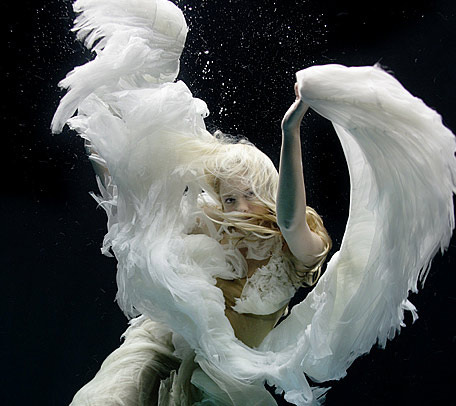
One of the best experiences I have ever been through would have to be my underwater photo shoot. One of the main inspirations from this particular shoot was Zena Holloway. Her work is all based on a typical fashion shoot, except it is always shot underwater. I found this incredibly interesting and somewhat different, so decided to give it a go myself. Here are a few pieces of Holloway's work:
From looking at Holloway's work, this gave me the push to try an underwater shoot myself. I rented out part of a local swimming pool and used one model. I used a disposable underwater camera and swan behind the model as she flipped and dived in and around the water. The images came out really well, so I decided to add to them by scanning in painted paper and a variety of collage pieces to add to the photos. I was slightly disappointed with the quality of the images because some of them came out incredibly grainy. This was because I had used a disposable camera, and not a professional underwater camera. My model was incredibly patient because I wanted the photos to be unique. I decided that I did no want my model to wear any floating clothes like in Holloway's, so that I could pick up the flow of the water, rather than the eye being drawn straight to the clothes in the image. Well, anyway, here they are...
Strange?
I was recently reminded of a photographer that I researched at college. She was a slightly strange artist whose work revolved around abnormal things...Diane Arbus.
According to the Canadian Medical Association Journal, "The subjects of Arbus photos often stood alone, separate from the world, almost as icons of divergence from the norm. Even though Arbus was widely criticized for her take on her art, she actually felt her photos were lyric and tender and called her subjects "aristocrats." To me, it almost seems unfair to single people out for being 'different', and penalizing them for their slight differences. However, this sense of differentiation makes a very interesting series of work - ranging from a giant to a boy with down syndrome. Arbus often referred to her subjects as 'circus acts', however did treat them all with great respect and made sure they were comfortable in their situation.
Arbus' work was often known as a 'freak show', but if it was, why was it so popular? It drew the audience in because it was something completely different to what people had seen before. She used a special camera that produced square shaped images and often her subjects look sad, conflicted or physically abnormal - but they do not try to hide their insecurities; they openly stare at the camera. One art expert said Diane Arbus turned photography inside out because instead of looking at her subjects, she made them look at her. Arbus learned to mix the realistic nature of photography with its other possibilities. She explored how people live with sameness and difference as well as rejection and acceptance. These combinations created very interesting art that was often disputed by fellow artists and photographers.
I for one find her work both interesting and inspiring. Although it does show a different range of people than usual photographers, I think that the world needs to see this to accept that there are lots of different people out there. People need to see a variety of different people before they completely accept that everyone varies. Arbus lets the people stay in their own environment, making them feel welcome and involved with her work, which I think is really important. To have a good relationship between photographer and subject is one of the most important things you can have in the art world, as I mentioned in a previous post.
According to the Canadian Medical Association Journal, "The subjects of Arbus photos often stood alone, separate from the world, almost as icons of divergence from the norm. Even though Arbus was widely criticized for her take on her art, she actually felt her photos were lyric and tender and called her subjects "aristocrats." To me, it almost seems unfair to single people out for being 'different', and penalizing them for their slight differences. However, this sense of differentiation makes a very interesting series of work - ranging from a giant to a boy with down syndrome. Arbus often referred to her subjects as 'circus acts', however did treat them all with great respect and made sure they were comfortable in their situation.
Arbus' work was often known as a 'freak show', but if it was, why was it so popular? It drew the audience in because it was something completely different to what people had seen before. She used a special camera that produced square shaped images and often her subjects look sad, conflicted or physically abnormal - but they do not try to hide their insecurities; they openly stare at the camera. One art expert said Diane Arbus turned photography inside out because instead of looking at her subjects, she made them look at her. Arbus learned to mix the realistic nature of photography with its other possibilities. She explored how people live with sameness and difference as well as rejection and acceptance. These combinations created very interesting art that was often disputed by fellow artists and photographers.
I for one find her work both interesting and inspiring. Although it does show a different range of people than usual photographers, I think that the world needs to see this to accept that there are lots of different people out there. People need to see a variety of different people before they completely accept that everyone varies. Arbus lets the people stay in their own environment, making them feel welcome and involved with her work, which I think is really important. To have a good relationship between photographer and subject is one of the most important things you can have in the art world, as I mentioned in a previous post.
"A photograph is a secret about a secret. The more it tells you the less you know."
Subscribe to:
Posts (Atom)