Friday, 20 April 2012
Diving into Photography
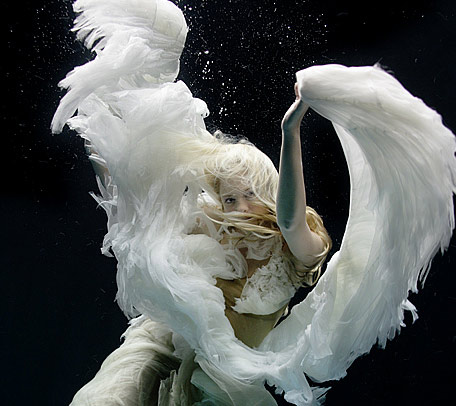
One of the best experiences I have ever been through would have to be my underwater photo shoot. One of the main inspirations from this particular shoot was Zena Holloway. Her work is all based on a typical fashion shoot, except it is always shot underwater. I found this incredibly interesting and somewhat different, so decided to give it a go myself. Here are a few pieces of Holloway's work:
From looking at Holloway's work, this gave me the push to try an underwater shoot myself. I rented out part of a local swimming pool and used one model. I used a disposable underwater camera and swan behind the model as she flipped and dived in and around the water. The images came out really well, so I decided to add to them by scanning in painted paper and a variety of collage pieces to add to the photos. I was slightly disappointed with the quality of the images because some of them came out incredibly grainy. This was because I had used a disposable camera, and not a professional underwater camera. My model was incredibly patient because I wanted the photos to be unique. I decided that I did no want my model to wear any floating clothes like in Holloway's, so that I could pick up the flow of the water, rather than the eye being drawn straight to the clothes in the image. Well, anyway, here they are...
Strange?
I was recently reminded of a photographer that I researched at college. She was a slightly strange artist whose work revolved around abnormal things...Diane Arbus.
According to the Canadian Medical Association Journal, "The subjects of Arbus photos often stood alone, separate from the world, almost as icons of divergence from the norm. Even though Arbus was widely criticized for her take on her art, she actually felt her photos were lyric and tender and called her subjects "aristocrats." To me, it almost seems unfair to single people out for being 'different', and penalizing them for their slight differences. However, this sense of differentiation makes a very interesting series of work - ranging from a giant to a boy with down syndrome. Arbus often referred to her subjects as 'circus acts', however did treat them all with great respect and made sure they were comfortable in their situation.
Arbus' work was often known as a 'freak show', but if it was, why was it so popular? It drew the audience in because it was something completely different to what people had seen before. She used a special camera that produced square shaped images and often her subjects look sad, conflicted or physically abnormal - but they do not try to hide their insecurities; they openly stare at the camera. One art expert said Diane Arbus turned photography inside out because instead of looking at her subjects, she made them look at her. Arbus learned to mix the realistic nature of photography with its other possibilities. She explored how people live with sameness and difference as well as rejection and acceptance. These combinations created very interesting art that was often disputed by fellow artists and photographers.
I for one find her work both interesting and inspiring. Although it does show a different range of people than usual photographers, I think that the world needs to see this to accept that there are lots of different people out there. People need to see a variety of different people before they completely accept that everyone varies. Arbus lets the people stay in their own environment, making them feel welcome and involved with her work, which I think is really important. To have a good relationship between photographer and subject is one of the most important things you can have in the art world, as I mentioned in a previous post.
"A photograph is a secret about a secret. The more it tells you the less you know."
Tuesday, 17 April 2012
A completely different view of a photograph
David Hockney
So here is something I have ALWAYS wanted to try.......Photomontage.
I came across Hockney's work during my GCSE Art course a few years ago. Since then, whenever I have looked at composition or montage, I have always gone straight to Hockney's work. I love the way he uses a variety of images of a specific thing to make an enlarged version of that particular thing... His work is inspiring and really clever, that is why he is one of my favourite photographers of all time. When looking through a variety of his photomontage images, I prefer the images that use larger pieces to create the final image. I think I prefer these because you can see that it is a montage much more clearly, whereas in some images (such as the one above) it is not immediately clear to the viewer that it is a montage of smaller images.
However, from a lot of research into Hockney's work, I particularly like the image above because he has not filled the whole frame with images. He has chosen a particular pattern in which to fill with smaller images. I think this looks better than the other images because he could then play around with the background, having maybe a detailed background that compliments the images. I think that Hockney's work is so visually inspiring that I will try and give it a go later in the course.
Shattering Expectations
Guy Bourdin
One of the photographers that I often come across when researching controversial work is Bourdin. In 1950, Bourdin met Man Ray and became his assistant; creating a range of interesting and beautiful fashion pieces. He was one of the best known photographers of fashion and advertising of the second half of the 20th century. However, he started to develop a love for controversy and stylization - but because Bourdin had such a formal narrative power, he overcame the boundaries of controversial advertising photography.
Bourdin was the first photographer to create a 'complex narrative' - then quickly take a moment - sexual, provocative, shocking, surrealistic, sometimes even sinister. That was why to the outside world, his work was so controversial. These narratives that he created were often strange, mysterious, and filled with violence and sex. I really like his images because hardly any of them include the model's face. I think this is really interesting because instead he has chosen to just photograph their feet and/or legs. The composition in all of his images is first class and the colours in every image draws the eye straight to the model.
Although I do like Bourdin's images, I am wary that it is rumoured that he was incredibly cruel to his models during shoots. Bourdin is said to have arrived on the back of a camel to the offices of French Vogue and attempted to dye the sea a deep blue in the days long before Photoshop! He was an interesting character and this is definitely seen in all of his work...but that is why I for one love it.
Queer...?
"Queer" by Sunil Gupta
I picked this book up by chance when browsing in the library. It has to be one of the most interesting photography books I have looked at. Gupta has looked at contemporary gay life in India and other parts of the world. He aims to tackled issues of gender and sexuality, and also documented his own experiences living with HIV.
I think what drew me to the book is the title. The word 'Queer' is plastered across the front cover, surrounded with pink and purple tones, and a man wearing a glittery mask. The front cover itself draws the reader in, and once you open the actual book, you do get sucked into the life of the men portrayed in the book. Although some images may seem almost humorous, like the ones above...the deep meaning always shines through - the tackling of inequality. A lot of the images are staged to make the models seem more 'queer' and feminine than they actually are, but I think that is the kind of picture Gupta is trying to create about the book as a whole - that they should not be ashamed of the people they are.
As I mentioned earlier, Gupta put a section in the book about his fight with HIV, called "Love and Light". This was a series of self portraits showing his battle. This is a small, but heart-wrenching part of the book, and really touches the reader. At the start of the section, you can see how the HIV took over his life completely, but by the end of the section, the images show him smiling and getting back on track with his life. The small part of the book shows an incredibly difficult part of Gupta's life and I think that it took guts to actually produce it in a book.
Monday, 16 April 2012
When You're a Boy: Men's Fashion Styled by Simon Foxton - The Photographers Gallery
"When You’re a Boy" celebrates men in fashion photography, particularly the men who create photographs of men. It focuses on the career of a stylist rather than a photographer, and is the first exhibition devoted to the groundbreaking British menswear stylist Simon Foxton, whose career covers the last three decades - a time of profound change in fashion and style photography.
Although the gallery itself is small, the exhibition definitely took advantage of the limited space, covering every wall with a variety of different men's fashion pieces. It was incredibly creative and inspiring.
"When You’re a Boy" celebrates men in fashion photography, particularly the men who create photographs of men. It focuses on the career of a stylist rather than a photographer, and is the first exhibition devoted to the groundbreaking British menswear stylist Simon Foxton, whose career covers the last three decades - a time of profound change in fashion and style photography.
"Galliano's Warriors" photographed by Nick Knight, styled by Simon Foxton
When I went to see this exhibition, I was particularly interested in the work of Nick Knight, so when i knew that a lot of the exhibition would be situated around his work, I was already very pleased. I think that I grew so attached to the exhibition because of the diversity of the work there. The exhibition captured menswear’s spirit and energy in some of the most memorable fashion photographs of the period, it questioned the definition of masculinity, national identity and taste. It looked at the classic English men’s tailoring and how they are combined with contemporary sportswear design, street fashion and also looks at references to gay subcultures - to produce sophisticated fashion images for a range of brands and magazines.
Something Different...
Russ & Reyn
I came across Russ and Reyn's work on the internet and I found it incredibly clever and interesting. I knew that this kind of shadow photography could be done, but they created these images to perfection; making them look really life-like.
I absolutely love these images because they are so simple, yet so effective. The viewer is made to think that the mysterious hand shadows are real, and that is what makes the images so great. None of Russ and Reyn's images are really 'normal'. Each image is always taken with a simple background, and includes levitation, or strange costume, to make their work out of the ordinary. I really like their work because it does not fall into a particular category or genre. There is a snippet of every genre present in their work, and that is what makes me want to look at every single piece of their work.
The fact that there are so many different ideas in each and every photography makes the viewer want to go back and look at more and more of their images. They have definitely inspired me to look deeper into photography, and to look more at the things that aren't through the lens - but what I could add to the image in different ways. This is such a different way to approach photography, but is incredibly interesting at the same time. When searching for photographers in books and online, I have not come across another photographer who uses such bright colour, but so subtly. This is my main love for their images. The way that they are using everything that a fashion photographer would; i.e the colour, the clothes, the background - but to me, it is not fashion photography, it is deeper than that.
I came across Russ and Reyn's work on the internet and I found it incredibly clever and interesting. I knew that this kind of shadow photography could be done, but they created these images to perfection; making them look really life-like.
Shadow Drama - Russ and Reyn
I absolutely love these images because they are so simple, yet so effective. The viewer is made to think that the mysterious hand shadows are real, and that is what makes the images so great. None of Russ and Reyn's images are really 'normal'. Each image is always taken with a simple background, and includes levitation, or strange costume, to make their work out of the ordinary. I really like their work because it does not fall into a particular category or genre. There is a snippet of every genre present in their work, and that is what makes me want to look at every single piece of their work.
The fact that there are so many different ideas in each and every photography makes the viewer want to go back and look at more and more of their images. They have definitely inspired me to look deeper into photography, and to look more at the things that aren't through the lens - but what I could add to the image in different ways. This is such a different way to approach photography, but is incredibly interesting at the same time. When searching for photographers in books and online, I have not come across another photographer who uses such bright colour, but so subtly. This is my main love for their images. The way that they are using everything that a fashion photographer would; i.e the colour, the clothes, the background - but to me, it is not fashion photography, it is deeper than that.
Subscribe to:
Posts (Atom)